
Written by Dr. Jacob Bloom, Plastic & Reconstructive Surgeon.
Last updated: 10/26/2026
People often ask me where the scars from a facelift or neck lift will sit and whether anyone will be able to see them. The short answer is that I place these incisions in natural creases and hair-bearing areas so they are hidden at conversational distance, and in most cases the only person who ever sees them is the person cutting your hair. This matters most for patients with short hairstyles, men, and anyone who wears a ponytail, because concealment depends on where the incisions fall.
Key Takeaways
- Facelift and neck lift scars are placed in natural creases and hairlines so they are hidden at conversational distance.
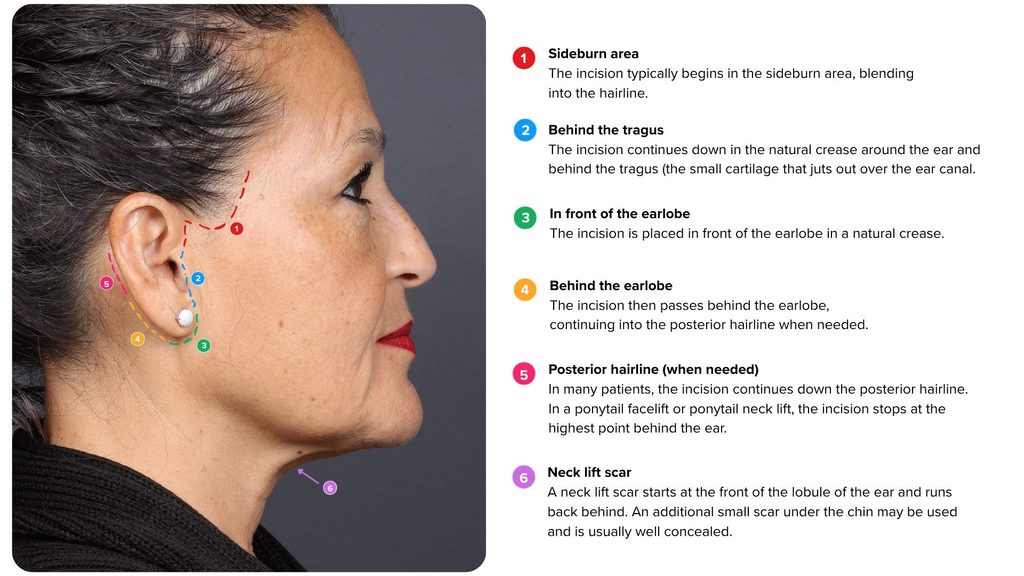
- Facelift scars run in the sideburn, the natural creases around the ear, behind the tragus, in front of and behind the earlobe, and sometimes down the posterior hairline.
- Scar healing takes about 6 wk to reach its maximum point, when scars look their worst, then fade over 3, 6, and 12 mo, looking their best at around 18 mo.
- Scar massage done multiple times per day can help scars fade for up to a year.
- A deep plane facelift removes tension from the skin incision, which helps scars stay thin and well hidden.
- IPL and fractional lasers can speed up fading, but most patients do not need them.
Why Facelift Scars Can Be Well Hidden
The reason these scars can be hidden is that they are placed in areas that are already in shadow or covered by hair at normal talking distance. The goal is concealment while still correcting the lower face and neck so you do not look windswept or over-pulled.
Facelift scars typically run in the sideburn area, down in the natural creases around the ear, behind the tragus (the small cartilage that juts out over the ear canal), in front of the earlobe, behind the earlobe, and sometimes down the posterior hairline. A neck lift scar starts at the front of the lobule of the ear and runs back behind. In a ponytail facelift or ponytail neck lift, the incision stops at the superior, or highest, point behind the ear. This is done in selected cases where there is not a significant amount of excess skin.
A scar underneath the chin is also usually concealed when we need direct access to the neck muscle and to confirm free motion of the skin around the jowl area. Keeping these scars hidden is especially important for patients with short hairstyles, male patients, or patients who wear ponytails.
Who Is Most Affected by Visible Scars?
Some patients are more likely to be concerned about visible scars than others, and the technique we choose is tailored to this.
Short hairstyles: less hair to cover the incisions, so placement matters more.
Male patients: often shorter hair and sideburns, so we take extra care with the sideburn area.
Patients who wear ponytails: we may use a ponytail approach so the incision stops at the highest point behind the ear.
Significant excess skin: a longer incision may be needed to correct the lower pole properly.
Older techniques, such as skin-only facelifts or lunchtime lifts that only pulled skin, created widened, spread scars that could drift into more visible areas. That is why technique really does matter.
What to Expect at Your Appointment
When you come in to discuss a facelift or neck lift, here is how the conversation typically goes.
- We review your goals and what bothers you about the lower face and neck.
- We examine the skin and the amount of excess skin, the jowl area, and the neck muscle.
- We discuss where the incisions will sit and how they will be concealed for your hairstyle.
- We talk through the healing timeline, including that scars look their worst at around 6 wk.
- We plan scar management, including massage and moisturizing, and whether lasers are right for you.
Scar Healing and Management for Facelift Incisions
My approach is to remove all tension from the scar with deep sutures, support healing with massage and moisturizing, and use lasers only when a patient wants to speed things up.
Deep Plane Facelift and Tension-Free Closure
With a deep plane facelift, the skin incision has little to no tension on it, and the edges are cut so that they are kissing and not pulling. Removing tension is one of the most important things we can do to keep scars thin and well hidden.
Scar Massage
Routine scar management with scar massage, done multiple times per day throughout the healing process, is recommended. Scar massage can help these areas fade for up to a year.
Suture Management and Moisturizing
A combination of removable permanent sutures and absorbable sutures is used depending on the area, and in some areas sutures do not need to be removed at all. External sutures in the incisions are kept in place for about 1 wk and then removed in the office. Early moisturizing is a key point for wound healing, and using Aquaphor or Vaseline for the first week helps the incisions stay hydrated.
IPL and Fractional Lasers
IPL lasers and fractional lasers can help reorganize the scar and speed up the process. That said, many patients can go through this process without lasers unless they wish to accelerate healing.
What I Tell My Patients About Facelift Scars
I tell my patients that scars end where they begin, and that healing is a process, not an event. Scar healing takes about 6 wk to reach its maximum point, which means that at 6 wk after surgery the scars look their worst. They can be red, lumpy, firm, indurated, and bumpy. This is a normal part of the healing process, and we do many things to help them fade.
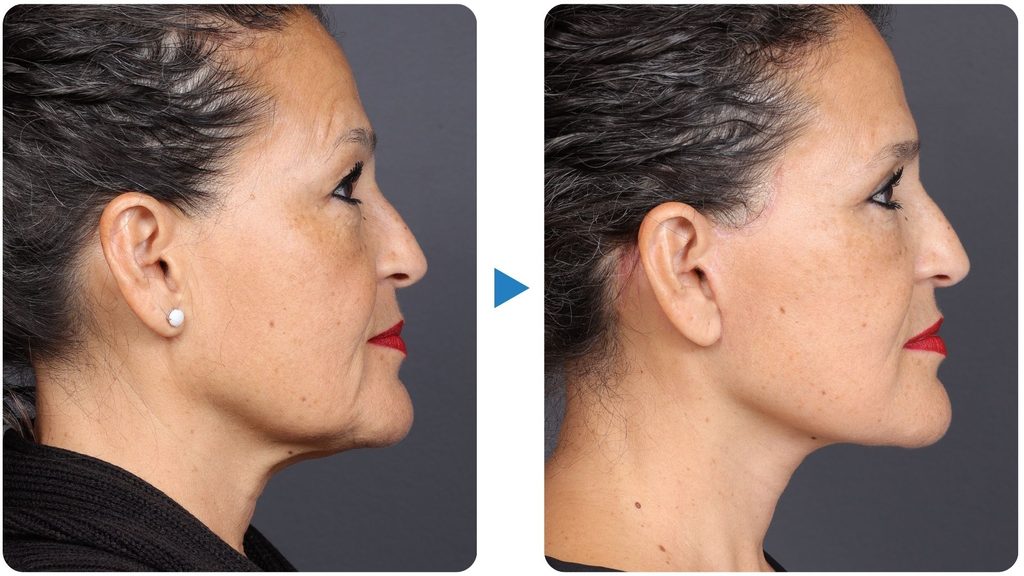
As the scar builds over the first 6 wk, it will then gently fade over 3, 6, and 12 mo, and scars look their best at around 18 mo. I remind patients that the only person who usually sees their facelift or neck lift scar is the person cutting their hair.
When Should You See a Doctor About Your Scars?
Most scar changes are normal, but some signs warrant a closer look.
- Scars that are spreading or widening over time.
- Scars that drift into more visible areas.
- Redness, firmness, or lumps that are not settling after the expected healing period.
- Any signs of infection at the incision sites.
If you have any of these concerns, book a visit so we can review your healing together.
Frequently Asked Questions About Facelift Scars
Will my facelift scars be visible to other people?
In most cases, no. Scars are placed in natural creases and hair-bearing areas so they are hidden at conversational distance, and the only person who usually sees them is the person cutting your hair.
When do facelift scars look their worst?
Scars look their worst at around 6 weeks after surgery, when they may be red, lumpy, and firm. This is a normal part of healing before they begin to fade.
How long until my scars look their best?
Scars gently fade over 3, 6, and 12 months and look their best at around 18 months. Scar massage done multiple times per day can help them fade for up to a year.
Do I need laser treatment for my scars?
Most patients do not need lasers. IPL and fractional lasers can help reorganize the scar and speed up fading, but they are optional for patients who wish to accelerate healing.
Do all of my stitches need to be removed?
Not always. A combination of removable permanent sutures and absorbable sutures is used, and in some areas sutures do not need to be removed at all. External sutures are removed in the office at about 1 week.
The Bottom Line
Facelift and neck lift scars are placed in natural creases and hair-bearing areas so they are hidden at conversational distance, and in most cases only your hairdresser will see them. The right technique, with tension-free deep sutures and careful placement, keeps scars thin and well concealed, while scar massage and moisturizing help them fade over the first year and a half. If you are thinking about a facelift or neck lift, come in and we can talk through exactly where your incisions would sit and what to expect during healing.